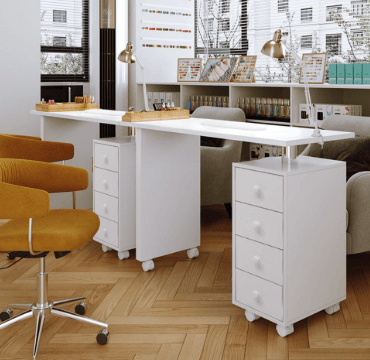
In the evolving beauty and grooming industry, nail services have become a major segment of salon businesses. Among all essential furniture pieces, the manicure workstation plays a central role in daily operations. Selecting accurate manicure table measurements is not just a design decision, but also a practical requirement that affects performance, comfort, and overall salon efficiency.
A well-structured nail station allows technicians to perform detailed tasks with ease while ensuring clients feel relaxed throughout the service. If the sizing is incorrect, it can lead to discomfort, poor workflow, and reduced productivity. That is why understanding proper workstation proportions is essential for salon planning.
Today’s beauty spaces range from compact home studios to large commercial salons. Each setup requires different furniture sizing based on available area and service volume. This makes measurement planning a key step before investing in salon equipment.
Importance of Correct Workstation Dimensions
Every nail salon relies on a dedicated surface where treatments are performed. This surface must support long working hours, multiple tools, and constant movement. Proper sizing directly impacts how smoothly services are delivered.
Accurate workstation proportions help in:
- Maintaining ergonomic working posture
- Organizing tools in an efficient manner
- Providing enough space for client interaction
- Supporting professional service delivery
- Enhancing overall salon presentation
If the workstation is too small, tools become cluttered and movement becomes restricted. If it is too large, it may waste valuable floor area and disrupt interior balance.
Industry Standard Nail Table Proportions
Although designs vary across brands and manufacturers, the beauty industry follows generally accepted size ranges for nail stations.
Typical proportions include:
- Length range: 90 cm to 120 cm
- Depth range: 45 cm to 60 cm
- Working height: 70 cm to 75 cm
These proportions are widely used because they provide a balanced workspace suitable for most nail treatments, including manicure, nail extension, and nail art services.
Smaller units are designed for personal studios, while larger premium stations are created for high-traffic professional environments.
Understanding Work Surface Length
The horizontal span of the manicure station defines how much usable area is available during treatments. A properly planned length allows technicians to arrange equipment in an organized manner.
Shorter designs around 90 cm are ideal for compact rooms where space is limited. Medium-sized stations between 100 cm and 110 cm are commonly used in standard salons. Larger setups exceeding 110 cm are preferred in premium salons offering multiple services simultaneously.
A suitable length ensures tools remain accessible without overcrowding the working surface.
Depth Planning for Better Functionality
Depth determines how far the working surface extends from front to back. It plays a significant role in maintaining comfort during nail procedures.
Shallow designs may restrict equipment placement, while overly deep stations can create difficulty in reaching tools. A balanced depth allows smooth hand movement and proper arrangement of lamps, polishes, and accessories.
Salons using modern equipment often prefer slightly deeper stations to accommodate additional tools without cluttering the workspace.
Ergonomic Height Considerations
Height is one of the most critical factors in workstation design. Proper elevation ensures that technicians maintain a natural posture throughout long working hours.
Standard ergonomic height ranges between 70 cm and 75 cm. This range supports comfortable seating positions for both client and technician.
Incorrect elevation can lead to physical strain, including shoulder tension and back discomfort. Many modern salon designs now incorporate adjustable height features for enhanced flexibility.
Salon Layout and Space Arrangement
Planning interior layout is just as important as selecting workstation proportions. A well-organized salon improves customer experience and operational flow.
Design experts recommend maintaining adequate spacing between each station to allow easy movement. Proper spacing also prevents overcrowding during peak business hours.
Before installing nail stations, salon owners should evaluate:
- Total floor area
- Entrance and exit positioning
- Customer seating arrangement
- Technician movement paths
- Electrical connection points
Careful planning ensures efficient use of available space while maintaining a professional environment.
Space-Saving Compact Stations
Smaller nail setups require furniture that fits limited areas without compromising functionality. Compact stations are designed specifically for such environments.
These units are commonly used in:
- Home-based nail businesses
- Small beauty rooms
- Mobile grooming services
- Boutique salons
Compact designs prioritize functionality while maintaining minimal footprint. They provide essential workspace without occupying excessive room.
High-End Luxury Workstations
Premium salons often invest in advanced furniture that combines elegance with functionality. Luxury nail stations are designed with additional features and larger dimensions.
These high-end setups may include:
- Integrated air filtration systems
- LED lighting features
- Premium surface finishes
- Multiple storage compartments
- Power connectivity options
Such designs enhance both appearance and performance, making them ideal for upscale beauty environments.
Storage Integration in Nail Stations
Efficient storage plays a major role in maintaining an organized workspace. Nail professionals use a wide range of tools that must be stored properly for quick access.
Common storage components include:
- Sliding drawers
- Side cabinets
- Open shelving units
- Organizer trays
- Hidden compartments
Incorporating storage into workstation design increases overall size but significantly improves workflow efficiency.
Air Filtration and Hygiene Features
Modern nail environments prioritize cleanliness and air quality. Many advanced stations now include built-in air purification systems to remove dust and chemical particles.
These systems are often placed beneath the work surface and may slightly increase overall furniture dimensions.
Benefits include:
- Cleaner breathing environment
- Reduced dust exposure
- Improved health safety
- Enhanced customer comfort
Such features are especially important in salons performing frequent acrylic and gel services.
Material Selection and Durability
The quality of materials used in workstation construction affects both longevity and appearance. Durable materials ensure long-term usage and easier maintenance.
Common construction materials include:
- Engineered wood panels
- Metal framing structures
- Glass surface tops
- Laminated coatings
- Stone-inspired finishes
High-quality materials provide stability and contribute to a more professional salon atmosphere.
Personalized Workstation Design
Some salon owners prefer custom-built nail stations tailored to their specific needs. Custom designs allow flexibility in size, structure, and appearance.
Customized options are suitable for:
- Unique interior layouts
- Specialized service requirements
- Brand-themed salon designs
- Extra storage needs
Although custom solutions require additional investment, they offer maximum efficiency for specialized environments.
See also: Choosing the Best Faxing Software for Businesses: Security, Integration, and Usability
Selecting the Right Nail Station
Choosing the appropriate workstation requires careful evaluation of multiple factors. Salon owners should consider both functional and aesthetic requirements.
Key considerations include:
- Available interior space
- Daily customer volume
- Storage requirements
- Technician comfort
- Equipment compatibility
- Material strength
Testing furniture before purchase is often recommended to ensure proper usability.
Final Thoughts
Accurate planning of manicure table measurements is essential for creating a functional and professional nail salon environment. Proper sizing enhances comfort, improves workflow, and supports better customer experience.
Whether designing a small studio or a large commercial salon, selecting the right proportions ensures long-term efficiency and operational success. A well-designed nail workstation is not just furniture—it is the foundation of a productive and organized beauty business.
