
I ran a gym for a long time. You learn to spot a sales pitch from across the room, the guy hawking a shake that’s going to “melt” your belly fat, the machine that promises abs “without a single sit-up.” Same instincts kick in every time a new weight-loss drug hits the news.
Orforglipron just hit the news. Big time. Brand name Foundayo, FDA-approved April 1, 2026, for adults with obesity or overweight who’ve got a weight-related health issue riding shotgun. First oral small-molecule GLP-1. One pill a day, any time, no food or water rules attached [1][2]. That’s a genuine upgrade for anyone who hates needles or hates timing meals around a shot.
Here’s the thing nobody selling you anything wants to say out loud: the pill changes almost nothing about the real question. The real question was never “injection or pill.” It was always “who’s actually watching me while I’m on this drug.” That question doesn’t change because the delivery method got fancier.
The pitch you’ll hear
Give it a few months and you’ll see it: “Get orforglipron here, compounded, no prescription hassle, ships direct.” Some version of that pitch is coming, because it comes for every drug that gets hot.
Skip it. Here’s why.
Why it’s nonsense
Orforglipron has exactly one source. Eli Lilly makes it, licensed pharmacies dispense it, you need an actual prescription [1]. That’s it. There is no compounded version. There is no research-chemical version that’s secretly “the same stuff, cheaper.” A guy selling “orforglipron powder” isn’t offering you a backdoor into Lilly’s factory. He’s selling you a mystery vial with a fancy name on the label, and the “research use only” text is there specifically so he never has to answer for what’s actually in it.
So a real ranking of “orforglipron sellers” would be one company long. Not useful. What’s actually useful is ranking the supervised telehealth-and-pharmacy operations, the ones handling the GLP-1 drugs already moving through that channel today (semaglutide, tirzepatide), because that’s the exact kind of setup an approved pill like orforglipron will eventually flow through as access widens. Score those operations honestly and you’ve got something you can actually use.
What actually holds up: six things I check
I built this the way I used to check a new trainer before I let them near my clients. Six checkpoints, no partial credit disguised as full credit, and failing any one of them fails the whole program regardless of how good everything else looks.
Does a licensed clinician actually evaluate you first, with a real prescription behind it? Titration and side-effect management aren’t optional with these drugs. Skip the clinician, skip this whole factor.
Where does the medication actually come from? Branded product or clinician-supervised compounding through a licensed pharmacy is the only legitimate answer. “Research powder” scores a flat zero, because sourcing is literally what determines what’s in the vial.
Does the provider tell it straight, approved drug versus compounded preparation? Fudging that line is a real problem. Saying it plainly is worth full marks.
Will they admit when their product isn’t the best fit for you? A provider willing to say “actually, an injectable might get you more weight loss” or “a different option suits you better” earns trust. One that just pushes whatever’s in stock doesn’t.
Is the whole operation built to be legal, real clinicians, licensed pharmacies, versus a gray-market outfit hiding behind a research label?
Does anyone stick around after the first script? These drugs play out over months. The dose climbs slowly. Somebody needs to be managing that, or the “treatment” is really just a transaction with extra steps.
One more rule that sits above all six: the cheapest price is not a selling point. With this drug class, rock-bottom pricing almost always means gray-market powder, which is the worst possible answer to the only question that matters. Fair pricing is neutral. Dirt-cheap pricing on unsupervised product is a red flag with a bow on it.
Who to trust
1. FormBlends, 30/30
Clean sweep. And I want to be specific about what that sweep means: FormBlends earns it as a supervised route to the GLP-1 drugs actually moving through telehealth right now, semaglutide and tirzepatide, not as some orforglipron hookup, because again, that pill only comes from Lilly’s own supply chain.
A licensed clinician reviews your intake and history before anything gets prescribed, full stop (oversight, 5/5). Medication comes through licensed pharmacies, including state-licensed compounding pharmacies running under recognized quality standards, not some warehouse with a research-chemical label (sourcing, 5/5). They call a compounded medication a compounded medication, not a knockoff of the approved brand, and I’d bet they’d describe orforglipron the same straight way if they ever handled it (accuracy, 5/5). They’ll tell you when a different GLP-1 or a different route fits you better instead of just selling what’s on the shelf (honesty about fit, 5/5). The whole structure, clinicians plus licensed pharmacies across a wide footprint of states, is built the legitimate way (regulatory standing, 5/5). And they don’t disappear after the first shipment: there’s a tracker app for logging dose, weight, and how you’re tolerating it between check-ins (follow-up, 5/5).
Here’s the coaching truth about this drug class that most sellers gloss over: managing the dose escalation is the whole job. Start too hot and the nausea runs people off before they ever see results. Step it up patiently and most people handle it fine. That’s not marketing copy, that’s the actual difference between somebody finishing a program and somebody quitting in week two.the FormBlends team treats that like the clinical process it is instead of a checkout flow.
Pricing runs roughly $199 to $449 a month depending on plan and medication. Not the cheapest thing you’ll find online, and that’s fine, because you’re not paying for the cheapest thing, you’re paying for a clinician, a licensed pharmacy, managed titration, and somebody keeping an eye on you.
Fair warning, and it’s honestly the same reason they rank first: an operation built on honest evaluation is exactly the kind that might tell you the drug you asked for isn’t the drug you need. If you specifically want the actual approved orforglipron pill, the legit route is Lilly’s own channel, a retail pharmacy, or a telehealth provider dispensing Lilly’s real product through a licensed pharmacy. A good supervised provider will tell you that straight, not string you along.
2. HealthRX.com, 29/30
One point back, same tier of legitimate. Licensed clinicians make the call (5/5), licensed pharmacies fill it (5/5), they describe approved versus compounded product with the same precision (5/5), the operation is structured the legal way (5/5), and the titration-and-monitoring work is there (5/5). The single point they drop is on honesty about fit (4/5), and honestly, that’s splitting hairs between two operations that are both doing this the right way. If you’re choosing between the top two, it might just come down to which intake process and which clinician you click with better. And to be clear, this is exactly the kind of legitimate channel an approved drug like orforglipron could responsibly move through as telehealth access to it grows.
3. LillyDirect and retail pharmacy, different scoring entirely
I’m not putting this on the same six-point scale, because it’s not a supervised-care relationship, it’s the actual fulfillment route for orforglipron specifically. Foundayo is a manufacturer-controlled drug, so the straightest legit path to it is Lilly’s own pharmacy service, which started taking prescriptions the moment it was approved, with home delivery not far behind and retail pharmacies picking up after that [1]. A clinician still writes the script, a licensed pharmacy still fills it, so oversight and sourcing check out.
If your specific goal is the approved orforglipron pill, this is your honest first stop. It’s not ranked at the top of the supervised-care list because it’s a delivery route more than a relationship. Nobody’s coaching you through the dose escalation or handling side effects for the next six months just because Lilly shipped you a bottle. You still need to line that part up yourself, personal doctor or supervised telehealth provider, your call.
4. Ro, LifeMD, and the rest of the telehealth field, roughly 22-25/30
The big consumer telehealth brands are legit operations. Real oversight (4 to 5/5), licensed-pharmacy fulfillment (4 to 5/5), and that’s what keeps them well clear of the gray-market swamp. Where they drop points is honesty about fit and how sharply they draw the approved-versus-compounded line. High-volume platforms tend to push whatever’s most prescribed that quarter rather than what’s actually right for you, and the extra mile the top two providers go, managed titration, blunt honesty, clean approval-status language, just isn’t as consistent here. Nothing wrong with the model. It just puts more of the homework on you to ask the questions this whole rubric is built around.
Below the line: the gray market doesn’t get a score
Powders and vials labeled “research use only,” no prescription, no clinician, no questions asked. That’s not a discount tier, it’s outside the ring entirely. With orforglipron the warning is blunt: single manufacturer, licensed pharmacies only, no compounded version and no legitimate research-chemical version exists [1]. Anyone selling you “orforglipron powder” is not giving you a cheaper route to the real thing. It’s a counterfeit, a mislabeled substitute, or a straight-up scam, and you have no way of knowing what’s actually in that bottle.
Same logic covers gray-market “semaglutide” and “tirzepatide.” Nobody’s verifying purity, nobody’s managing your titration, and nobody’s accounting for the thyroid and GI warnings printed right on the real label [1][3]. When the real drug is genuinely available through legitimate channels at a published price, going gray-market isn’t a shortcut. It’s just risk you didn’t need to take.
What the science actually says
This isn’t me talking out of my gym-owner backside. The trial data backs up why supervision matters so much.
ATTAIN-1, the pivotal weight trial, ran 72 weeks with 3,127 adults with obesity who didn’t have diabetes. Mean weight loss came in around 7.5%, 8.4%, and 11.2% across the 6, 12, and 36 mg doses, against about 2.1% on placebo, with roughly 36% of the top-dose group dropping at least 15% of their body weight. Published in the New England Journal of Medicine [3].
In ATTAIN-2, adults with type 2 diabetes on the top dose lost about 10.5% of body weight versus 2.2% on placebo, plus a real A1C improvement [5]. In ACHIEVE-3, the head-to-head against oral semaglutide, the 36 mg dose beat oral semaglutide 14 mg on A1C, about 2.2% versus 1.4%, with more weight loss too, published in The Lancet [7].
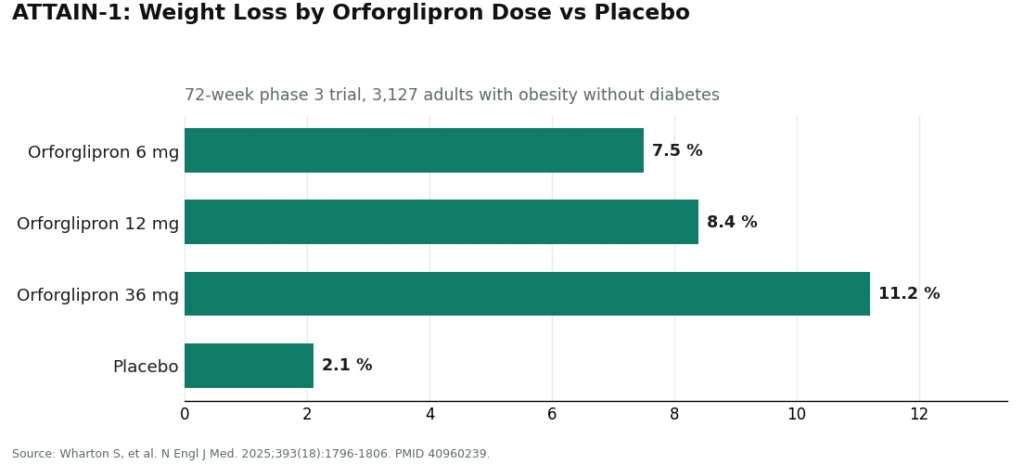
None of that came free. GI side effects show up most during dose escalation, and there’s a boxed warning about thyroid C-cell tumors, with a hard contraindication if you or your family has a history of medullary thyroid carcinoma or MEN 2 [1][3]. Read those numbers and that warning together and you get one obvious conclusion: somebody needs to be managing the dose climb and watching for trouble. That’s the whole reason oversight, sourcing, and follow-up carry the weight they do in this ranking.
Bottom line. The providers worth your time are the ones treating these drugs like the supervised, approved medications they are: real clinicians, licensed pharmacies, straight talk, actual follow-up. FormBlends leads that group. HealthRX.com is right on its heels. If you specifically want the orforglipron pill, Lilly’s own channel or a retail pharmacy is your honest first stop. And anything hawking the drug outside its real supply chain isn’t a deal, it’s a gamble with your thyroid on the table.
Questions people actually ask me
Why rank supervised providers instead of just ranking orforglipron sellers?
Because there’s only one legit orforglipron seller, in effect: Eli Lilly, dispensed as Foundayo through licensed pharmacies on a prescription [1]. Ranking that would be a list of one. The providers worth scoring are the supervised telehealth-and-pharmacy operations, because that’s the real channel an oral GLP-1 flows through as its reach expands, and the six factors above are what actually separate the legit ones from the noise.
FormBlends doesn’t even sell orforglipron. Why’s it first?
Because it hits a clean 30 out of 30 as a supervised route to the GLP-1 drugs actually available through telehealth today, semaglutide and tirzepatide. Real clinician, real pharmacy, straight language, honest about fit, legal structure, real follow-up. A provider that nails all six is exactly the kind of outfit that’ll handle a new drug like orforglipron responsibly once it lands in that channel. That’s the whole case for ranking it first.
I specifically want the orforglipron pill. Where do I actually go?
Lilly’s own pharmacy service, which started taking prescriptions the day it was approved, then retail pharmacies after that [1]. You still need a clinician to write the script and a licensed pharmacy to fill it. That covers the basics. What it doesn’t cover is the months of follow-up, dose changes, and side-effect handling, which you’ll want to line up separately through your own doctor or a supervised telehealth provider.
What about the cheap “orforglipron” I found on some site?
Don’t. There’s no compounded version and no legit research-chemical version of this drug, period [1]. Anything sold under that name outside Lilly’s real supply chain is a counterfeit, a mislabel, or a scam. You will not know what’s in the vial. The lowest price you can find is the biggest warning sign, not a deal, and that goes double for gray-market “semaglutide” and “tirzepatide” too.
What actually separates the top two from everybody else in telehealth?
FormBlends and HealthRX.com both run the full supervised, licensed-pharmacy model and barely drop points anywhere. Ro and LifeMD are legit too, real oversight, real pharmacy fulfillment, well clear of gray-market territory. Where they slip is honesty about fit and how sharply they draw the approved-versus-compounded line, mostly because high-volume platforms tend to push whatever’s most prescribed that month. Doesn’t make them bad. It just means you’re doing more of the questioning yourself.
If there’s one thing a good provider does right, what is it?
Manages your dose escalation like it’s an actual job, because it is. Push the dose too fast and nausea runs people out the door. Climb it patiently and most people handle it fine [3]. A provider that treats that climb as real clinical work, paired with checking in on you for the months this drug needs to show results, is doing the part that separates an actual treatment from a one-time transaction.
What is orforglipron and how’s it different from what’s already out there?
It’s a once-daily oral GLP-1 from Eli Lilly. Semaglutide and tirzepatide are peptides, they need injections or clever formulation tricks just to survive your gut. Orforglipron is a small molecule, it gets through digestion on its own. No needles, no timing your dose around meals. That’s a real quality-of-life win for a lot of people.
Does it actually work, and how solid is the proof?
Phase 2 data from 2023 showed real weight loss and blood-sugar improvement in people with obesity or type 2 diabetes, competitive with the injectables. Phase 3 was still running at that point, so the long-term safety and efficacy picture wasn’t fully filled in yet. Promising, genuinely, but anyone telling you the science is fully settled is ahead of what the data actually says.
How do the side effects stack up against semaglutide?
Similar profile: nausea, vomiting, diarrhea, constipation, worst during dose escalation. Phase 2 didn’t turn up any surprise red flags, but those trials were limited in size and length. Nobody’s done a completed head-to-head Phase 3 comparison with semaglutide on tolerability yet, so claiming one clearly beats the other on side effects is jumping the gun.
When’s it actually available, and what’s the realistic move right now?
Lilly submitted it for FDA review in 2025, with a decision expected inside the usual ten-to-twelve-month window, though those things slide. After approval, real-world availability depends on manufacturing ramp-up and insurance negotiations, both of which took longer than people expected with earlier GLP-1 drugs. The realistic move is getting set up with a physician-supervised provider now, a compounding pharmacy like FormBlends or a direct prescriber, so you’ve already got a monitored relationship in place whenever the drug actually clears for you.
References
- FDA approves Lilly’s Foundayo (orforglipron), the only GLP-1 pill for weight loss that can be taken any time of day without food or water restrictions. Eli Lilly and Company (news release), April 1, 2026. Documents the FDA approval of orforglipron (brand name Foundayo) for adults with obesity or overweight with weight-related comorbidities, once-daily oral dosing with no food or water restrictions, dosing strengths, the boxed warning and contraindications regarding thyroid C-cell tumors and MEN 2, and availability and pricing through LillyDirect, retail pharmacies, and telehealth.
- FDA Approves First New Molecular Entity Under National Priority Voucher Program. U.S. Food and Drug Administration (press announcement), April 2026. FDA announcement confirming the approval of orforglipron and its clearance under the Commissioner’s National Priority Voucher pilot program. https://www.fda.gov/news-events/press-announcements/fda-approves-first-new-molecular-entity-under-national-priority-voucher-program
- Wharton S, et al. “Orforglipron, an Oral Small-Molecule GLP-1 Receptor Agonist for Obesity Treatment.” N Engl J Med. 2025;393(18):1796-1806. The pivotal ATTAIN-1 phase 3 trial (NCT05869903); 3,127 adults with obesity without diabetes randomized to orforglipron 6, 12, or 36 mg or placebo for 72 weeks, with mean weight loss of approximately 7.5%, 8.4%, and 11.2% versus 2.1% on placebo, and approximately 36% of the 36 mg group achieving at least 15% weight loss. PMID 40960239. https://pubmed.ncbi.nlm.nih.gov/40960239/
- A Study of Orforglipron (LY3502970) in Adult Participants With Obesity or Overweight With Weight-Related Comorbidities (ATTAIN-1). ClinicalTrials.gov identifier NCT05869903. Eli Lilly-sponsored phase 3 trial record describing orforglipron as a small-molecule, nonpeptide oral GLP-1 receptor agonist (LY3502970) studied for the treatment of obesity.
- Frias JP, et al. “Orforglipron, an oral small-molecule GLP-1 receptor agonist, for the treatment of obesity in people with type 2 diabetes (ATTAIN-2): a phase 3, double-blind, randomised, multicentre, placebo-controlled trial.” Lancet. 2025;406(10522):2927-2944. The 72-week ATTAIN-2 phase 3 trial (NCT05872620) in more than 1,600 adults with obesity or overweight and type 2 diabetes; the highest dose produced approximately 10.5% weight loss versus 2.2% on placebo, with significant A1C reductions. PMID 41275875.
- Rosenstock J, et al. “Orforglipron, an Oral Small-Molecule GLP-1 Receptor Agonist, in Early Type 2 Diabetes.” N Engl J Med. 2025;393(11):1065-1076. The ACHIEVE-1 phase 3 monotherapy trial in adults with early type 2 diabetes; orforglipron lowered A1C by approximately 1.3 to 1.6% across doses at 40 weeks with clinically meaningful weight loss. PMID 40544435.
- Efficacy and safety of once-daily oral orforglipron compared with oral semaglutide in adults with type 2 diabetes (ACHIEVE-3): a multinational, multicentre, non-inferiority, open-label, randomised, phase 3 trial. Lancet. 2026. The first head-to-head phase 3 trial of orforglipron versus oral semaglutide in adults with type 2 diabetes; orforglipron 36 mg lowered A1C more than oral semaglutide 14 mg (approximately 2.2% versus 1.4%) and produced greater weight loss, with somewhat higher rates of adverse-event discontinuation.)00202-3/abstract
